

Why AI search matters for your website
AI tools are now citing sources in their answers, not just linking to them. If your site isn't set up for that, you're losing customers before they even click. Your future customers are not all coming from Google but from ChatGPT, Claude, Gemini (or Google’s AI Mode).
If your website hasn't been optimised for those tools, you are likely already losing ground to your competitors. The trends show that users are becoming more trusting of AI tools than of reading it for themselves. People visiting Oxford would now use an AI tool instead of searching through multiple websites to plan a day out.
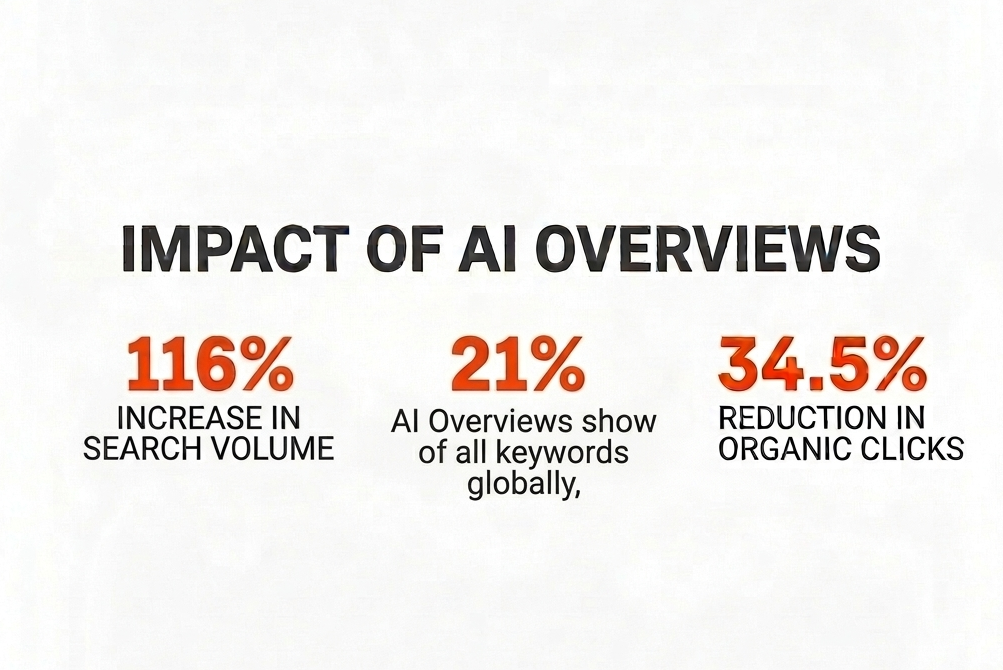
The way your website content is being found is no longer conventional. According to Ahrefs, there has been a 116% increase in the use of AI Overviews in Google Search results, leading to a 34.5% drop in users taking the time to explore organic links. GEO (Generative Engine Optimisation) and SEO (Search Engine Optimisation) need to work together.
During the 2025 holiday season, Adobe found that traffic to US retail sites from AI tools was up 693% on the year before. That's where your customers are starting their shopping journey.
“SEO isn’t dead. It’s not enough on its own”
Traditional SEO gets you onto Google's results page. Generative Engine Optimisation (GEO) gets you cited inside the AI answers themselves. They work together, not against each other, and good GEO is built on the same foundations as good SEO: authoritative content, a fast, well-built site, and genuine expertise.
76% of AI Overview citations are pulled from pages ranking in Google's top 10 organic results. Your traditional SEO work isn't wasted, it's foundational.
When someone types “best whisky under £40” into ChatGPT or asks an AI tool for a product recommendation, those tools don’t return a list of links. They generate an answer and pull from sources they consider trustworthy, well-structured, and authoritative. Research from Princeton University found that simply adding figures and statistics to your content can increase AI citation rates by up to 40%.
It’s worth noting that this space has attracted a lot of noise. Some so-called GEO experts are pushing spammy shortcuts: flooding the web with AI-generated content, manufacturing fake “best of” lists, or stuffing pages with NLP terms. These tactics will backfire, just as keyword stuffing did. The businesses that will win in AI search are those that do the fundamentals properly.
What AI tools actually look for
ChatGPT, Gemini and Claude each work slightly differently, but they share the same core signals when deciding which sources to reference:
- Authority and trust. Established sites with a clear area of expertise are consistently preferred over generic sites.
- Structured data. Schema markup (Product, Review, FAQ, Organisation) tells AI tools what your site is and what you sell, in a format they can read.
- Specific, citable content. Facts, statistics, expert quotes and unique insights are far more likely to be referenced than vague, generic copy.
- Crawlability. If AI bots can't access your site, they can't cite it. Many sites block AI crawlers without realising it (see fix 1 below).
- Reviews and brand mentions. Volume and consistency of mentions across trusted platforms builds your brand’s reputation within AI knowledge bases. Google, Trustpilot, industry directories and sector-specific review sites all contribute.
Why specialist retailers have an advantage
Here’s something most generic ecommerce platforms miss: AI tools don’t just favour big brands. They favour depth of expertise. And specialist retailers are often sitting on exactly the kind of content AI wants to cite.
Think about how people are already using these tools. Someone asks ChatGPT, “What wine pairs with slow-roasted lamb?” or “What’s a good whisky for someone moving from bourbon?” The retailer with genuine, well-structured expertise wins every time.
Detailed product knowledge, buying guides, comparison content, producer stories, and regional expertise. This is the content that answers real questions. It has value to your customers, and it has value to AI. The key is making sure it’s formatted in a way AI can actually read and use: clear headings, direct answers, and structured data.
5 fixes you can make right now
You don’t need to rebuild your site. A few targeted changes can make a meaningful difference:
- Check your robots.txt. This is the file that controls which tools can access your site. Many businesses are accidentally blocking AI crawlers like GPTBot and ClaudeBot without realising it.
- Review how your content is delivered. Most AI crawlers cannot render JavaScript. If key content on your site loads dynamically, it may not be visible to AI tools at all.
- Add Product and Review schema to your product pages. Structured data gives AI tools the context they need to understand and reference your products accurately.
- Write content that directly answers questions. Think about what your customers are already asking AI tools and make sure your site has clear, authoritative answers.
- Build your presence on review platforms and directories. Consistent mentions across trusted third-party sites strengthen your brand’s authority in AI knowledge bases.
At Open Imagination, we are a Drupal web agency. We develop ecommerce solutions using open-source technology because it offers flexibility and transparency. Drupal properly manages all the aspects we've discussed: schema markup, clean content architecture, and crawlability.
Get a free AI search review
Want to know if AI search can find your website? We'll review your site for free and show you what's helping, what's blocking you, and what to fix first. It's a 30-minute call, and you'll keep the list of fixes either way.