
Blog
Drupal's Practical Guide to GEO and AEO

Overview
Search has changed, and your website needs to change with it. Search engines now answer questions with AI before they list the usual results, so your customers are moving away from typing keywords and towards asking full questions in their own words.
This guide shows you how to get your content recognised in those AI answers, using SEO (Search Engine Optimisation), GEO (Generative Engine Optimisation) and AEO (Answer Engine Optimisation), and how Drupal gives you an unfair advantage over other platforms. Our client The Wine Reserve is already surfacing well in Google Gemini, so we know this works. Now the jargon is out of the way, let's dive in.
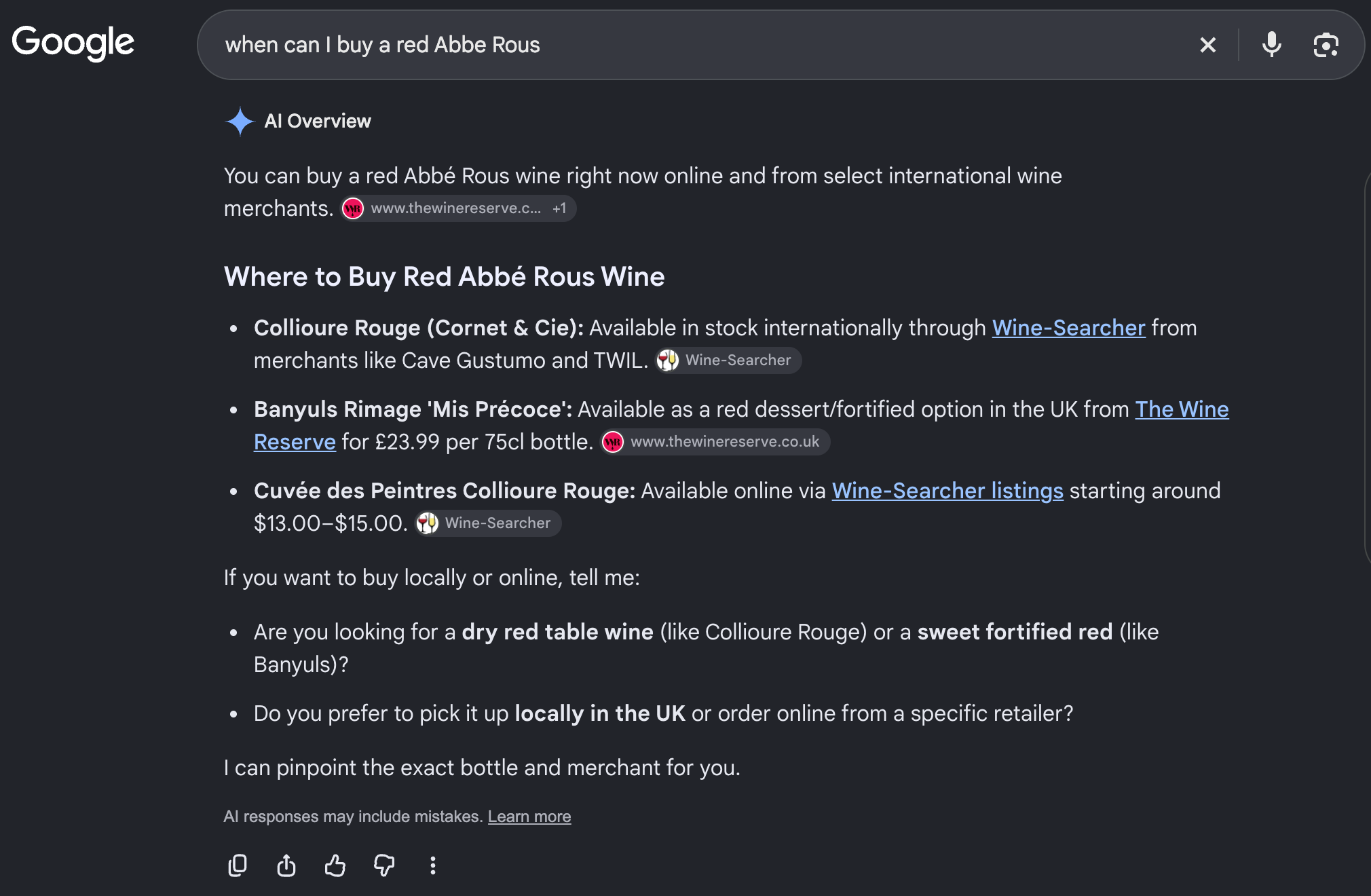
This result shows that our client, The Wine Reserve, is surfacing well with Google Gemini
The Framework
As search engines answer questions directly with AI, the click-through to a website can fall sharply. Studies in 2025 found organic click-through can drop by up to 60 percent when an AI Overview appears. Getting into those answers is not straightforward, so four pillars give you the best chance of being recognised, and SEO remains the foundation they all stand on.
Four pillars, on an SEO and technical foundation
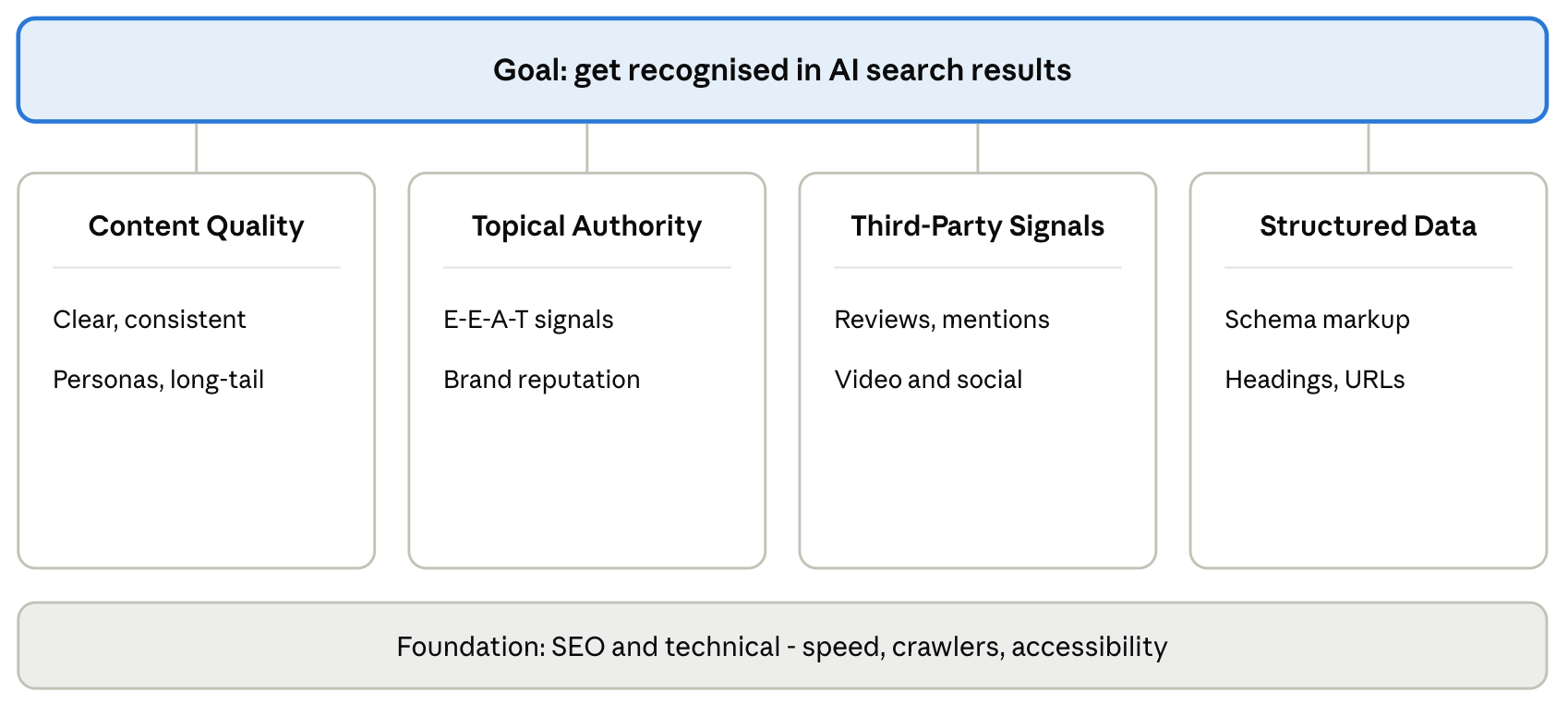
Strengthen all four pillars on a solid SEO and technical base, and you give AI search every reason to recognise and recommend you.
Pillar 1: Content Quality
Good content is the foundation everything else stands on. High-quality content reinforces your brand's professionalism and authority, and it gives an LLM a clear, consistent read of who you are. Aim for content that is:
- Semantically relevant to the question a customer is really asking
- Clear and easy to follow
- Complete and consistent
- Rich in long-tail queries, the longer, more specific phrases people now type into AI
Make sure any fact you state is backed up in more than one place and that the versions match. For example, "13 years in business" can sit on your About Us page, but it should also line up with Companies House and your homepage, so nothing contradicts itself.
Clear Messaging
Clear messaging comes from a consistent brand writing style. Decide where you sit on each of these and hold that line across the site:
- Formal to Casual
- Serious to Funny
- Respectful to Irreverent
- Matter-of-fact to Enthusiastic
In Drupal 11, a contributed AI module, Context Control Center, can score your content against these criteria and your brand guidelines, which keeps quality consistent when you have many content editors.
Personas
Personas are commonly used to help define your brand tone of voice and understand your audience. They help you write in a language your audience is familiar with and comfortable reading. If you need help with Personas or would like access to a library of Personas, try https://userpersona.dev/.
Knowing your audience also helps support positive reviews and ensures your content doesn't target customers who don't value your product or services, so audience sentiment aligns with your offering. For example, someone looking for a £5 bottle of wine and not interested in detail should go to Aldi, but someone looking to explore new flavours and wines for the experience is likely to spend more with a trusted professional in this space.
Pillar 2: Topical Authority
Authority comes from what other people say about you, not just what you say about yourself. If you are a well-known brand with a strong reputation, that reputation is built on the opinions of your customers and partners. We are lucky to have a collection of strong strategic partners who believe our services are second to none, which is why they refer their clients to us.
Think about where your brand sits. John Lewis has a reputation for quality and honest pricing, though not the cheapest. Home Bargains has a reputation for low prices over quality. Each has earned its place with its own customer base, and an LLM has learned those positions from the wider web.
Search engines and LLMs weigh this up using E-E-A-T:
- Experience
- Expertise
- Authority
- Trustworthiness
So the question to answer is simple. Where is your brand positioned now, and does the content across the web support the position you want? If you want to influence your SEO, GEO and AEO, you need a clear answer to that.
Pillar 3: Third-Party Signals
These are the off-site signals that back up your trustworthiness and authenticity. When your customers post a positive review or statement about you on another platform, such as LinkedIn, Reddit, Trustpilot or Google Reviews, your own content is scored more highly. Some sources are trusted more than others, so it is worth knowing which ones carry weight in your trade.
Unfortunately, they won't do it unless you ask. Make it a habit to ask happy customers and suppliers to share something that promotes your services. For our wine retailers, the authoritative sources include IWSC, WSET, The Wine Merchant, Decanter and BBC Saturday Kitchen.
Video is one of the strongest ways to earn these signals at scale. When you publish video content, your audience shares and comments on it across LinkedIn, YouTube and Instagram, which gets people talking about you in public. The same goes for creating genuinely useful content that others want to link to from their own websites.
Pillar 4: Structured Data
Structured data is how you spell out a page for machines so they can't misread it. It covers the schema markup behind the page, your heading structure, and the way your URLs are organised.
Schema markup
Schema is the markup that gives search engines and LLMs a clean read of your page. Google uses it to build rich results, and it gives any machine a tidy summary of what your page is about. In Drupal this is built into the Metatag module, where schemas can be switched on or off and applied to pages dynamically with tokens, or an administrator can edit them on each page. The schema validator is a good way to check you have it right. You will find worked examples further down.
Heading and content structure
Use a clear heading hierarchy, H1 through to H4, so the page reads in a logical order for both people and machines. Optimise your headers around the questions you answer, and use strong internal linking to connect related pages and reinforce your main topics.
URL structure
Keep your URLs clean and descriptive, because they help readers and reinforce what a page is about. A tidy structure funnels visitors towards your most important pages, the ones that convert, such as a product detail page or a contact page. For a wine shop that might look like:
- /champagne
- /champagne/france
- /champagne/france/taittinger
- /red-wine/pinot-noir
One honest note. Folder depth itself is not a ranking signal, so a deep path does not weaken a page. What gives a page weight is strong internal linking and clearly signalling its importance, not how many slashes sit in the URL.
Location and language
Your address and location matter more than you might think. They help your content surface to the right market, so a UK merchant writing in UK English is served to UK customers rather than a US or German audience looking for something different.
The Drupal Advantage
This is where Drupal earns its place. The four pillars apply to any website, but Drupal makes them far easier to deliver and keep on top of, which is the advantage we bring to a project.
- AI content scoring. A contributed AI Context Control Center (CCC) module scores your content against your quality criteria and brand guidelines, so quality holds up even with a large team of editors.
- Dynamic schema. The Metatag Schema module builds your structured data for you, applying the right schema to each page with tokens, with per-page overrides when you need them.
- Control over AI crawlers. Your robots.txt and firewall rules decide which AI crawlers may read your site. Allowing them is usually the right call for GEO, though it is a genuine business choice, since some publishers block them to protect their content.
- Fast and accessible by default. Site speed and accessibility are built into how we construct a Drupal site, and the same clear structure that helps an LLM read your page also meets accessibility standards, so one piece of work serves both.
Put together, these turn the pillars from a wish list into something you can actually run and maintain.
Page Template and Worked Example
A strong, repeatable page structure helps an LLM read your page and understand exactly what your product or service is. It follows the same principles as writing for accessibility, so one layout serves both your visibility and your compliance. Build your key pages from these seven parts, in order:
- Overview - a short, high-level summary so a reader or an LLM gets the gist in the first few lines.
- Details - the main content, where you explain the product or service in full.
- Examples - real and specific. For our drinks retailers, that means product comparisons; for our service providers, it means case studies.
- FAQs - the questions your page answers, written out so LLMs can lift those answers straight into a response.
- Stats and key facts - the evidence behind your authority, such as years in business, awards or ratings.
- Summary points - quick, scannable facts a reader can act on. For a wine that might be: 2016 red, under thirty pounds, pairs with steak.
- How-to steps - clear instructions for getting the best from the product, such as decanting before serving to let the wine breathe and bring out the aromas.
Giving an LLM the context first, then the detail, then the proof, is the same order a customer needs to feel confident enough to buy.
Worked example: The Wine Reserve
Here is the structured data behind a real client. The first part tells search engines who the business is. The second describes a single product. The opening hours are trimmed here for space. The live site lists all seven days.
https://www.thewinereserve.co.uk/product/zuccardi-apelacion-paraje-altamira-cabernet-franc
{
    "@context": "https://schema.org",
    "@graph": [
        {
            "@type": "LiquorStore",
            "url": "https://www.thewinereserve.co.uk/",
            "sameAs": [
                "https://www.instagram.com/thewinereserve2010/",
                "https://www.facebook.com/thewinereserve/"
            ],
            "name": "The Wine Reserve",
            "description": "Independent local fine wine merchants selling quality champagne, wines and spirits.",
            "contactPoint": {
                "@type": "ContactPoint",
                "telephone": "+44 1932 866682",
                "url": "https://www.thewinereserve.co.uk/"
            },
            "logo": {
                "@type": "ImageObject",
                "url": "https://www.thewinereserve.co.uk/themes/custom/grapes_base/assets/images/wine-reserve-logo-no-text.png",
                "width": "590",
                "height": "588"
            },
            "openingHoursSpecification": [
                {
                    "@type": "OpeningHoursSpecification",
                    "dayOfWeek": "Monday",
                    "opens": "10:00:00",
                    "closes": "19:00:00"
                },

                {
                    "@type": "OpeningHoursSpecification",
                    "dayOfWeek": "Sunday",
                    "opens": "11:00:00",
                    "closes": "16:00:00"
                }
            ],
            "address": {
                "@type": "PostalAddress",
                "streetAddress": "7 Oakdene Parade, High Street",
                "addressLocality": "Cobham",
                "addressRegion": "Surrey",
                "postalCode": "KT11 2LR",
                "addressCountry": "GB"
            },
            "geo": {
                "@type": "GeoCoordinates",
                "latitude": "51.329579",
                "longitude": "-0.411676"
            }
        },
{
"@type": "Product",
"name": "Zuccardi Apelacion Paraje Altamira Cabernet Franc 2023",
"description": "From selected vineyards in the Uco Valley, ruby red in colour with firm tannins; great fresh fruit aromas with lush acidity and a long finish. It can be consumed now but will age beautifully for several years.",
"url": "https://www.thewinereserve.co.uk/product/zuccardi-apelacion-paraje-altamira-cabernet-franc",
"category": "Food, Beverages & Tobacco > Beverages > Alcoholic Beverages > Wine",
"image": {
"@type": "ImageObject",
"url": "https://www.thewinereserve.co.uk/sites/default/files/vintner/vintner-images/AACFR17B.PNG",
"width": "800",
"height": "2400"
},
"offers": {
"@type": "AggregateOffer",
"price": "19.99",
"lowPrice": "19.99",
"highPrice": "19.99",
"priceCurrency": "GBP",
"itemCondition": "https://schema.org/NewCondition",
"availability": "https://schema.org/InStock",
"category": "purchase",
"eligibleRegion": {
"@type": "Country",
"name": "GB"
}
},
"sku": "AACFR17B",
"brand": {
"@type": "Brand",
"name": "Zuccardi"
}
}
]
}10 Checks Before You Publish
- You know your brand tone of voice and have held it across the page
- You know your audience and have written for the right customer
- Every key fact is consistent with your other pages and outside sources
- The page follows the seven-part structure, Overview through to How-to steps
- FAQs are written out as full questions and answers
- Schema markup is in place and passes the schema validator
- Headings run in a clean H1 to H4 order with strong internal links
- You have asked happy customers or partners for a review or mention
- AI crawlers are allowed in robots.txt, if that is your chosen approach
- The page passes your standard SEO and accessibility checks
How to Work With Us
If you would like to understand how AI search could affect your business, I am happy to talk it through before any work starts, so you can see the potential impact first.
If you have a Drupal website and want help configuring it for AI search with its latest AI features, please book a call, and we will put together a work plan.
What is the difference between SEO, GEO and AEO?
SEO gets your pages ranked in the traditional results. GEO gets your content used in the AI-generated answers that now sit above those results. AEO focuses on being the direct answer to a specific question. They overlap, and SEO remains the foundation for all three.
Will AI search kill my website traffic?
It changes it. When an AI Overview appears, studies in 2025 found organic click-through can fall by up to 60 percent, so the goal shifts from winning the click to being the source the AI quotes and the brand it recommends.
Do I need to let AI crawlers onto my site?
To be included in AI answers, yes, you need to allow them in your robots.txt and firewall rules. It is a business choice, as some publishers block them to protect content, but for most drinks retailers wanting visibility, allowing them is the right call.
Why does Drupal help with this more than other platforms?
Drupal builds your structured data for you through the Metatag module, can score content quality with AI, and gives you fine control over crawlers, speed and accessibility, all from one place. That makes the four pillars far easier to deliver and keep current.
How do I get started?
Pick one important page, run it through the key points above, and fix the gaps. Once you have the pattern on one page, you can roll it out across the site.